Loading
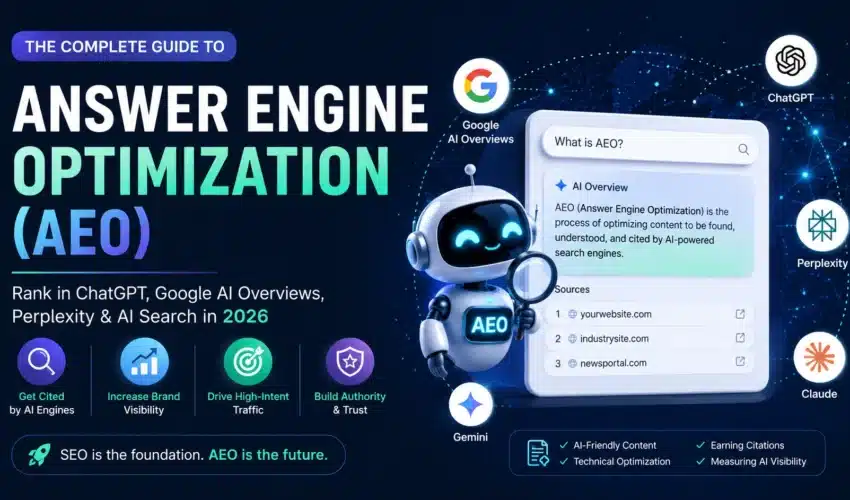
Artificial Intelligence is changing how people search online. Instead of clicking through 10 blue links, users now get direct answers from platforms like ChatGPT, Google AI Overviews, AI Mode, Perplexity, Gemini, Claude, and Copilot.
This shift has created a new optimization strategy called Answer Engine Optimization (AEO).
If traditional SEO helps websites rank on search engines, AEO helps brands get cited, mentioned, and recommended by AI systems.
In this complete guide, you’ll learn:
Answer Engine Optimization (AEO) is the process of optimizing your website, content, and brand so that AI-powered search engines like ChatGPT, Google AI Overviews, Google AI Mode, Perplexity, Claude, Gemini, and Microsoft Copilot can find, understand, cite, and recommend your content in their answers.
Traditional SEO helps your website rank in Google Search.
AEO helps your content become the answer.
As AI search continues to grow, businesses that appear in AI-generated answers gain more authority, brand visibility, and high-converting traffic.
Search behavior is changing rapidly.
Users are now asking:
Instead of showing a list of websites, AI platforms provide direct answers.
If your business is not being cited by AI systems, your competitors may be getting visibility that previously came through Google Search.
The biggest opportunity today is that AI traffic is still relatively small, but conversion rates are often much higher because users have already completed much of their research before clicking.
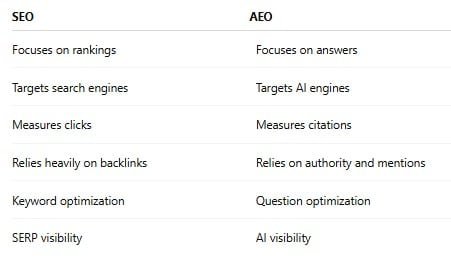
One of the biggest misconceptions in digital marketing is that AEO will replace SEO.
The reality is that SEO remains the foundation of AEO.
Search engines and AI systems both rely on high-quality content, authority signals, and user trust. However, their goals differ.
Traditional SEO focuses on helping web pages rank in search engine results.
AEO focuses on helping content become the answer generated by AI systems.
Most AI systems use two information sources.
Large Language Models are trained using massive datasets collected from across the internet.
These datasets may include:
The AI uses this information to learn language patterns, concepts, and relationships between topics.
However, training data has limitations.
It may be outdated.
It may not include recent events.
It may not contain your latest website content.
This is why modern AI systems also rely on real-time information retrieval.
Platforms such as ChatGPT Search, Perplexity, and Google AI Overviews retrieve fresh information directly from the web.
When a user submits a question, the AI system typically follows this process:
Step 1: Understand the Question
The AI analyzes the user’s intent.
For example:
“Who is the best mortgage broker in Sydney for healthcare professionals?”
The system identifies:
Step 2: Search the Web
The AI searches relevant sources.
Step 3: Evaluate Content
The system identifies trustworthy and authoritative pages.
Step 4: Extract Information
Important details are collected and summarized.
Step 5: Generate an Answer
The AI creates a human-friendly response.
Step 6: Add Citations
Trusted sources may be cited or linked.
This is where AEO becomes important.
If your content is well-structured, authoritative, and relevant, it may become one of the sources selected by the AI system.
Not all AI visibility is the same.
Businesses typically fall into one of three categories.
This is the ideal outcome.
Your website is cited and linked within an AI-generated answer.
Benefits include:
When users see your website cited repeatedly, trust naturally increases.
Sometimes AI systems reference a company or brand without providing a direct link.
Although traffic may be limited, these mentions still contribute to:
Repeated mentions help establish your organization as a recognized expert within your industry.
The final category is complete invisibility.
The AI system never references your content, services, or expertise.
Unfortunately, many businesses currently fall into this category.
Their competitors receive all the visibility while their own content remains undiscovered.
The purpose of AEO is to move from invisible to cited.
Successful Answer Engine Optimization follows four stages:
Phase 1: Assessment
Understand current AI visibility.
Phase 2: Discovery
Identify keyword and prompt opportunities.
Phase 3: Execution
Create optimized content and earn citations.
Phase 4: Measurement
Track AI traffic and visibility growth.
One of the biggest mistakes businesses make when starting Answer Engine Optimization is jumping straight into content creation without understanding how AI platforms currently perceive their brand.
Before creating new articles, videos, or landing pages, you need to identify your Brand Gap.
A Brand Gap Analysis helps you understand:
Think of it as an SEO audit for AI search.
Instead of checking rankings, you’re checking AI visibility.
A Brand Gap Analysis is the process of comparing how AI platforms view your business against how you want your business to be perceived.
For example, you may want your company to be known for:
However, AI systems might only associate your business with traditional SEO.
This creates a gap between your desired positioning and your current AI visibility.
Your goal is to close that gap.
Before analyzing visibility, you need to identify all the entities connected to your business.
AI systems understand brands through entities.
Entities are things such as:
Let’s use an SEO agency as an example.
WebBeast Digital Solutions
Create a spreadsheet and list all these entities.
This becomes your AI visibility benchmark.
Now it’s time to test visibility.
Open ChatGPT, Perplexity, Gemini, Claude, and Google AI Mode.
Ask questions that potential customers may ask.
Examples:
Record every response.
Create a spreadsheet.
Document:
You may discover that competitors appear repeatedly while your brand is never mentioned.
This reveals an immediate visibility gap.
Now analyze the responses.
Ask:
If yes:
If no:
List every competitor.
For example:
| Brand | Mentioned |
| Competitor A | Yes |
| Competitor B | Yes |
| Competitor C | Yes |
| Your Brand | No |
This simple exercise often reveals why competitors dominate AI search visibility.
Once you’ve collected data, categorize the gaps.
AI mentions competitors but not your brand.
Example:
ChatGPT recommends three SEO agencies in Kochi.
Your company is not included.
This indicates low AI visibility.
Competitors have content covering topics you don’t.
Example:
Competitors publish:
Your website only covers traditional SEO.
Result:
AI associates competitors with modern AI search topics.
Competitors publish multiple content formats.
Examples:
Your website only contains service pages.
AI often prefers brands with broader content coverage.
How AI describes competitors versus your business.
Example:
AI describes Competitor A as:
“An industry-leading AI Search Optimization agency.”
AI describes your business as:
“A digital marketing company.”
This means competitors own stronger positioning.
Competitors receive citations from:
Your website has very few external mentions.
AI systems trust cited brands more.
This is where the real opportunity appears.
Ask AI:
Why are competitors being mentioned?
Investigate:
You may discover they have:
This helps prioritize your AEO strategy.
ow convert insights into actions.
Create content.
Example:
Missing Topics:
Create these articles immediately.
Increase brand mentions.
Focus on:
Expand content formats.
Create:
AI platforms frequently cite content from multiple formats.
Focus on earning mentions from trusted websites.
Build relationships with:
The more trusted sources mention your brand, the more likely AI systems are to recognize your authority.
Let’s assume your company wants to rank for:
You ask ChatGPT:
“Who are the best SEO agencies in Kochi?”
Results:
Your company is missing.
You then investigate.
You discover competitors have:
Your website only contains service pages.
The solution becomes obvious:
Create authoritative AEO content, publish videos, earn mentions, and strengthen entity signals.
Over time, AI systems begin associating your brand with these topics.
Brand Gap Analysis is the starting point for every successful AEO campaign.
Before creating more content, understand how AI systems currently view your business.
Identify:
✔ Visibility Gaps
✔ Topic Gaps
✔ Format Gaps
✔ Narrative Gaps
✔ Citation Gaps
Once you know where the gaps exist, you can create a focused AEO strategy that increases citations, improves AI visibility, and helps your brand become a trusted source in AI-generated answers.
Keyword research remains essential.
Start with:
For an SEO company in Kochi:
Add modifiers such as:
Comparison
Best
How-To
Cost
Industry-Specific
Keywords show what people search.
Prompts show what people ask AI.
Examples:
These prompts become content opportunities.
Many people believe long content automatically wins.
Not true.
Content length matters less than content quality.
A 700-word page can outperform a 3,000-word article if it answers the question better.
Give the answer immediately.
Example:
What is AEO?
AEO is the process of optimizing content for AI search engines like ChatGPT, Google AI Overviews, and Perplexity.
Then explain the details.
Each section should answer one question.
Avoid giant paragraphs.
Example:
What is AEO?
Answer.
Why does AEO matter?
Answer.
How to implement AEO?
Answer.
AI understands entities.
Include:
Example:
Instead of:
We offer SEO services.
Write:
WebBeast Digital Solutions provides Local SEO, Technical SEO, GEO, and AEO services for businesses in Kochi, Kerala, Dubai, and USA.
AI systems prefer clarity.
Good:
AEO helps websites get cited in AI-generated answers.
Bad:
The utilization of advanced optimization methodologies facilitates enhanced discoverability.
The best-performing formats include:
Examples:
Examples:
FAQs
Examples:
AI systems often cite:
Show real results.
AI models frequently reference unique data.
One of the fastest AEO wins:
Update old pages.
Add:
Updated content often gains greater AI visibility.
AI systems frequently pull information from three source categories.
Examples:
These are among the strongest citation sources.
Examples:
AI systems frequently reference community discussions.
Participate genuinely.
Avoid spam.
Build your digital ecosystem:
The more trusted assets you control, the more visibility opportunities you create.
YouTube visibility is becoming increasingly important.
Many AI systems regularly reference YouTube videos.
Search:
Identify successful formats.
Optimize Titles
Example:
How to Rank in Google AI Overviews (AEO Guide 2026)
Place primary keywords in the first few lines.
Include:
AI transcription systems analyze spoken content.
Mention:
naturally throughout the video.
Study top-performing videos and improve upon them.
Your robots.txt file tells search engines and AI crawlers which parts of your website they can access. As AI-powered search platforms become more important, it’s essential to review your robots.txt settings and ensure that valuable content is not accidentally blocked.
Where appropriate, allow access to major AI crawlers, including:
Allowing trusted AI crawlers to access public content can improve your visibility in AI-generated search results, answer engines, and conversational AI platforms.
An llms.txt file is an emerging standard designed to help large language models (LLMs) better understand your website’s most important content. Similar to a sitemap, it provides AI systems with clear guidance about key pages, resources, documentation, services, and business information.
A well-structured llms.txt file can improve content discoverability, help AI systems identify authoritative pages, and increase the likelihood of your content being referenced in AI-powered search experiences.
Many AI crawlers and search engines have limitations when processing complex JavaScript-heavy websites. To ensure your content is fully accessible and understandable, focus on improving how your site renders content.
Best practices include:
This helps both traditional search engines and AI systems accurately interpret your pages.
Fast websites provide a better user experience and are easier for search engines and AI systems to crawl efficiently. AI platforms often need to crawl, process, and segment content quickly. Slow-loading pages can reduce accessibility and limit how effectively your content is analysed.
To improve page speed:
Faster websites support both SEO and AI search visibility.
A logical content structure helps users, search engines, and AI systems understand the hierarchy of information on your pages.
Follow these content organisation best practices:
Clear structure improves readability and helps AI systems extract accurate information from your content.
Schema markup provides structured data that helps search engines and AI systems understand your content with greater accuracy. It adds context to your pages and can improve eligibility for rich results, knowledge panels, and AI-generated summaries.
Recommended schema types include:
Implementing relevant schema markup strengthens machine understanding and improves the way your content is interpreted across both traditional search engines and AI-powered discovery platforms.
As AI-powered search platforms such as ChatGPT, Gemini, Perplexity, Claude and Microsoft Copilot continue to influence how users discover information online, businesses need new ways to measure the effectiveness of their AEO strategy. Traditional SEO metrics remain important, but they should now be supplemented with AI-specific tracking and reporting.
One of the most effective ways to measure AEO performance is by identifying traffic coming from AI platforms. Google Analytics 4 allows businesses to create custom channel groups that classify visits from AI-powered sources separately from traditional organic search traffic.
Consider creating dedicated channels for:
By segmenting this traffic, you can better understand how AI platforms contribute to website visits, enquiries and revenue.
Once AI traffic channels are configured, regularly track the following metrics:
Monitor the number of website visits originating from AI platforms. Increasing session numbers may indicate that your content is being surfaced and referenced more frequently within AI-generated responses.
Track contact form submissions, phone calls, quote requests, appointment bookings and other lead generation actions that originate from AI traffic sources.
Measure how effectively AI-driven visitors convert compared to users from traditional search engines, paid advertising and social media channels. In many industries, AI-referred users may demonstrate stronger purchase intent because they often receive highly relevant recommendations before visiting your website.
Review metrics such as:
These indicators help determine whether AI-referred users are finding valuable information on your website.
In addition to monitoring human visitors, it is useful to track AI crawler activity. AI bots regularly visit websites to discover, analyse and update information used within their language models and search experiences.
Monitor crawl activity from bots such as:
Regular bot visits can indicate that AI systems are accessing and processing your content. Log file analysis tools and server monitoring platforms can help identify crawl frequency, requested URLs and indexing patterns.
Key metrics to review include:
This information can help you optimise content accessibility for AI systems.
Search for your business, products, services and industry-related keywords within AI platforms on a regular basis.
Evaluate:
Tracking these mentions provides valuable insight into your visibility within emerging AI search ecosystems.
One of the simplest and most effective ways to measure AEO success is to collect attribution data directly from customers.
Add a field to enquiry forms, booking forms, contact forms and onboarding questionnaires asking:
“How did you hear about us?”
Suggested response options include:
This first-party attribution data can reveal customer discovery patterns that may not be fully visible within analytics platforms.
Not every customer will visit your website immediately after interacting with an AI platform. Many users conduct research through AI tools before returning later through branded searches, direct visits or referrals.
For this reason, businesses should monitor:
These indicators often provide a clearer picture of AEO performance than relying solely on last-click attribution.
To effectively evaluate your AEO strategy, create a dedicated monthly report that includes:
By consistently monitoring these metrics, businesses can gain a clearer understanding of how AI search platforms influence customer acquisition and identify opportunities to improve their visibility across ChatGPT, Gemini, Perplexity, Claude and other emerging answer engines.
Use this checklist every month.
✅ Review robots.txt
✅ Check AI crawler access
✅ Create or update llms.txt
✅ Refresh important pages
✅ Add AI-focused FAQs
✅ Publish comparison content
✅ Publish industry guides
✅ Monitor AI traffic
✅ Conduct brand gap analysis
✅ Track AI mentions
✅ Build editorial mentions
✅ Participate in Reddit and Quora
✅ Improve YouTube visibility
✅ Add schema markup
✅ Fix broken URLs
Answer Engine Optimization is becoming a critical part of digital marketing.
The brands that win in AI search will not simply publish more content. They will publish better content, earn trusted mentions, build authority across multiple platforms, and create information that AI systems can easily understand and cite.
SEO gets you found.
AEO gets you recommended.
Businesses that invest in both today will have a significant competitive advantage as AI search continues to grow.
Getting cited by ChatGPT, Google AI Overviews, Perplexity, and other AI search platforms doesn’t happen by accident. It requires the right combination of SEO, AEO, GEO, technical optimization, authority building, and content strategy.
I’m Anitha, an SEO, Local SEO, GEO, and AI Search Optimization Specialist with 9+ years of experience helping businesses improve their online visibility and generate qualified leads.
Whether you’re a local business, finance company, healthcare provider, law firm, real estate agency, or eCommerce brand, I can help you:
✅ Improve visibility in Google Search and AI Search
✅ Optimize content for ChatGPT and Google AI Overviews
✅ Increase local rankings and organic traffic
✅ Build authority and brand mentions across the web
✅ Track AI traffic and AI-generated leads
✅ Develop a complete SEO, GEO & AEO strategy
Discover how your website currently performs in Google Search, ChatGPT, Perplexity, and AI-powered search engines.
Your audit includes:
AI Visibility Analysis
SEO Performance Review
Competitor Analysis
Content Gap Analysis
Local SEO Opportunities
AEO & GEO Recommendations
📞 Book Your Free Consultation Today
Let’s discuss how your business can generate more traffic, leads, and sales from both traditional search engines and the next generation of AI search platforms.
